Choosing the correct road bike size is essential for comfortable riding, efficient pedaling, and better bicycle control. Whether you’re a beginner or an experienced cyclist, understanding frame measurements can help prevent discomfort and improve performance. This road bike size chart by height helps you select the right frame using your height, inseam, and body proportions. You’ll also discover men’s and women’s sizing recommendations, popular brand size charts, and practical tips for measuring your road bike frame correctly.
Road Bike Size Chart by Height
Road bike frames are available in different sizes to accommodate riders of various heights and body proportions. Most manufacturers identify frame sizes in centimeters, although some use inches or letter-based categories such as XS, S, M, and L. The following general road bike sizing chart helps you estimate the appropriate frame size before comparing manufacturer recommendations.
Road Bike Frame Size Chart in CM and Inches
| Rider Height | Frame Size (CM) | Frame Size (Inches) | General Size |
| 4’10″–5’2″ (147–157 cm) | 44–47 cm | 17.3–18.5″ | XXS–XS |
| 5’2″–5’5″ (157–165 cm) | 48–50 cm | 18.9–19.7″ | XS–S |
| 5’5″–5’7″ (165–170 cm) | 51–52 cm | 20.1–20.5″ | S |
| 5’7″–5’10” (170–178 cm) | 53–54 cm | 20.9–21.3″ | M |
| 5’10″–6’0″ (178–183 cm) | 55–56 cm | 21.7–22.0″ | M–L |
| 6’0″–6’2″ (183–188 cm) | 57–58 cm | 22.4–22.8″ | L |
| 6’2″–6’4″ (188–193 cm) | 59–60 cm | 23.2–23.6″ | XL |
| 6’4″–6’6″ (193–198 cm) | 61–62 cm | 24.0–24.4″ | XL–XXL |
Note: These are approximate traditional frame-size equivalents, not universal sizing standards. Modern road bikes may use nominal sizes that differ from actual seat-tube measurements. Always check the specific bicycle model’s size chart.
Road Bike Size Chart by Inseam
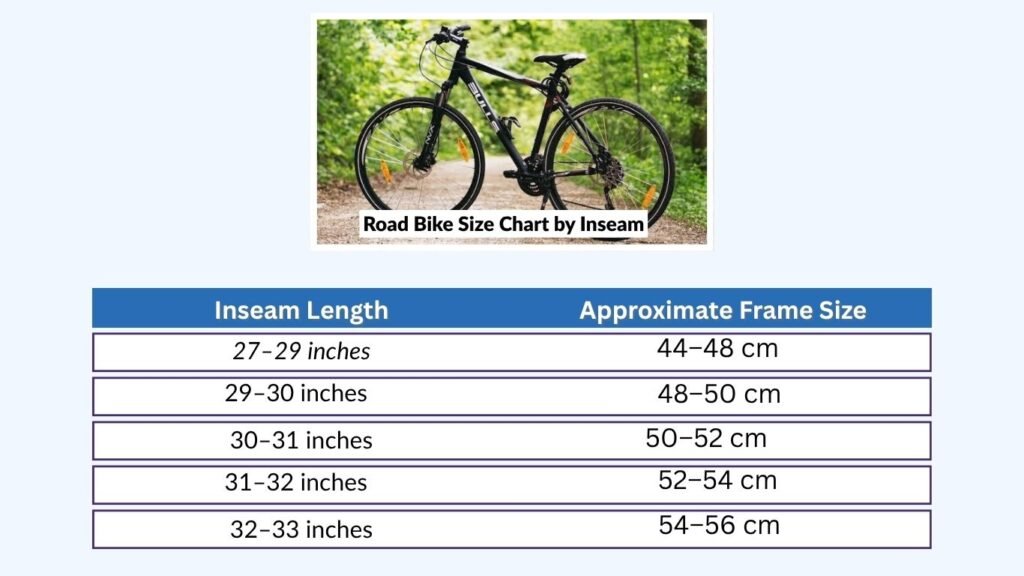
Inseam length helps determine the appropriate frame size and saddle height. Two cyclists of identical height may require different frames because of variations in their leg and torso proportions.
| Inseam Length | Approximate Frame Size |
| 27–29 inches | 44–48 cm |
| 29–30 inches | 48–50 cm |
| 30–31 inches | 50–52 cm |
| 31–32 inches | 52–54 cm |
| 32–33 inches | 54–56 cm |
| 33–35 inches | 56–58 cm |
| 35–37 inches | 58–62 cm |
These ranges are broad starting estimates. The manufacturer’s geometry chart and riding position should determine your final choice.
How to Measure Road Bike Frame Size
Measuring a road bike frame correctly helps you understand whether a bicycle matches your height and body proportions. Traditional road bike sizing often refers to seat-tube length, while modern manufacturers also consider effective top-tube length, stack, and reach. Combining these measurements with your inseam provides a more accurate assessment of bicycle fit than relying on height alone.
1. Measure Your Height and Inseam
- Measure Height: Stand barefoot against a wall and measure from the floor to the top of your head.
- Measure Inseam: Place a hardcover book firmly between your legs and measure from its upper edge to the floor.
- Record Measurements: Write down both measurements in centimeters.
- Compare Size Charts: Check the recommended height and inseam range for your chosen bicycle.
- Confirm Fit: Consider standover clearance and handlebar reach before purchasing.
2. Measure the Road Bike Seat Tube
Traditional road bike frames are commonly measured from the center of the bottom bracket along the seat tube.Some manufacturers measure to the top of the seat tube, while others use the center of the top-tube junction.For example, a nominal 54 cm road bike frame is commonly considered a medium size, although the actual seat-tube length may differ.
3. Check Stack and Reach
Stack measures the vertical distance from the bottom bracket to the top of the head tube. Reach measures the horizontal distance between these points.These measurements help determine handlebar position and the rider’s upper-body posture.Two road bikes with identical nominal frame sizes may feel different because their stack and reach measurements differ.
Women’s and Men’s Road Bike Size Charts

Women’s and men’s road bikes may have different saddles, handlebars, and frame geometries. However, bicycle sizing depends primarily on height, inseam, torso length, and individual riding preferences rather than gender. Many manufacturers offer unisex road bike frames with adjustable components. Comparing body measurements and bicycle geometry is generally more reliable than selecting a size solely from a gender-specific label.
Women’s Road Bike Size Chart
Women can use the general height chart when selecting a suitable road bike.For example, a woman measuring 5’2″ may begin by comparing 47–49 cm frames, while a rider measuring 5’6″ might consider approximately 51–52 cm.Some cyclists prefer shorter handlebar reach or narrower handlebars, but these requirements depend on individual proportions.
Men’s Road Bike Size Chart
Men’s road bike sizing follows the same measurement principles.A rider measuring 5’9″ will commonly consider a 54 cm frame, while someone measuring 6’1″ may begin with a 56–58 cm model.However, the ideal size depends on inseam length, upper-body proportions, and the bicycle’s geometry.
Trek and Specialized Road Bike Size Charts
Road bike manufacturers use different sizing systems, meaning a 54 cm frame from one brand may fit differently from another. Popular brands such as Trek and Specialized offer multiple road bike models with distinct geometries. Frame sizes may also change between model generations. Understanding these differences is important when comparing endurance, racing, and recreational road bicycles.
Trek Road Bike Size Chart
Trek road bicycles include models such as the Domane and Madone.Recent Trek road bikes increasingly use letter-based sizing, although numerical size references remain common.For example, certain Madone models identify a medium frame as approximately 52–54 cm and a large frame as approximately 58 cm.Always verify the model and year before selecting a Trek road bike size.
Specialized Road Bike Size Chart
Specialized offers road bicycles such as the Allez, Tarmac, and Roubaix.These models have different geometries and may provide distinct riding positions even when their nominal sizes match.For instance, a 54 cm Tarmac and a 54 cm Roubaix are not necessarily identical in reach or handlebar height.Use the manufacturer’s model-specific geometry chart when comparing Specialized frames.
Giant and Cannondale Road Bike Sizes
Giant commonly uses XS, S, M, ML, L, and other letter-based sizes on its road bicycles.Cannondale often uses numerical frame sizes, including 48, 51, 54, 56, and 58 cm, depending on the model.Because the sizing systems differ, compare height recommendations and frame geometry rather than relying exclusively on letter or numerical labels.
How to Choose the Right Road Bike Size

Choosing a road bike involves more than selecting a recommended frame measurement. Riding posture, flexibility, handlebar reach, and saddle position influence comfort and efficiency. Racing bicycles often feature lower handlebars and longer riding positions, while endurance road bikes usually prioritize comfort. Evaluating these characteristics helps you find a frame that suits your cycling goals and physical proportions.
Important Factors to Consider
- Rider Height: Determines the approximate frame size range.
- Inseam Length: Helps assess standover clearance and saddle adjustment.
- Frame Reach: Influences how far you stretch toward the handlebars.
- Frame Stack: Affects handlebar height and upper-body positioning.
- Saddle Position: Supports comfortable knee movement during pedaling.
- Riding Style: Racing and endurance cycling may require different geometries.
- Handlebar Width: Should suit your body proportions and riding preferences.
What If You Are Between Two Sizes?
If your height falls between two road bike sizes, compare both frames before buying.A smaller frame may offer a more compact riding position, while a larger frame may provide additional reach and stack.The best choice depends on your inseam, torso length, flexibility, and preferred riding posture.A professional bike fitting can help determine which geometry suits your measurements.
Common Road Bike Sizing Mistakes
Many cyclists purchase incorrectly sized road bikes because they depend entirely on height charts or assume that frame measurements are consistent across manufacturers. Although charts offer a useful starting point, choosing the right bicycle requires additional attention to geometry and body proportions. Avoiding common sizing mistakes can improve riding comfort, handling, and efficiency over longer distances.
Mistakes to Avoid
- Ignoring Inseam Measurements: Height alone cannot determine the ideal frame.
- Confusing Wheel Size with Frame Size: A 700c wheel does not indicate frame dimensions.
- Assuming All 54 cm Bikes Fit Identically: Geometry varies between brands.
- Choosing an Oversized Frame: Excessive reach may cause discomfort.
- Overlooking Handlebar Height: Incorrect positioning can strain the shoulders and back.
- Skipping a Test Ride: Riding the bicycle helps confirm real-world comfort.
FAQs
1. What Size Road Bike Do I Need for My Height?
Your recommended road bike size depends on height and inseam. Generally, a rider measuring 5’7″–5’10” may consider a 53–54 cm frame. Always compare your measurements with the specific manufacturer’s sizing guide.
2. What Size Road Bike Is Best for a 5’9″ Rider?
A 5’9″ rider will commonly fit a road bike around 54 cm. However, inseam length, torso proportions, and frame geometry may make a slightly smaller or larger bicycle more appropriate.
3. Is a 54 cm Road Bike Medium or Large?
A 54 cm road bike is generally classified as medium, although some manufacturers use different categories. It commonly suits riders around 5’7″–5’10”, depending on the frame geometry.
4. What Is the Difference Between Trek and Specialized Road Bike Sizing?
Trek and Specialized use different geometry and sizing conventions. Trek increasingly uses letter-based sizing for newer road bikes, while many Specialized models retain numerical sizing. Compare exact model measurements rather than assuming equivalent labels provide identical fits.
5. How Do I Know If My Road Bike Is Too Big?
A road bike may be too large if you struggle to reach the handlebars comfortably, feel excessively stretched while riding, or lack adequate standover clearance. Persistent discomfort despite reasonable adjustments may indicate that a smaller frame or different geometry is needed.
